Top LAUSD Schools with Empty Seats Shut Out Needy Students, Report Says
As LA Unified’s enrollment shrinks, a local dad-turned-activist found nearly 7,000 empty seats in high-performing schools.

;)
Education news and commentary, delivered right to your inbox.
Sign up for The 74 newsletter.
Get stories like this delivered straight to your inbox. Sign up for The 74 Newsletter
Dozens of highly-rated Los Angeles Unified schools in wealthy neighborhoods have empty seats — but most students can’t access them, according to a new analysis of state enrollment data.
“,” a 36-page report published by a nonpartisan nonprofit led by Tim DeRoche, an author and parent who lives in Los Angeles, draws on official attendance data for LAUSD’s zoned elementary schools for the years 1995 to 2024.
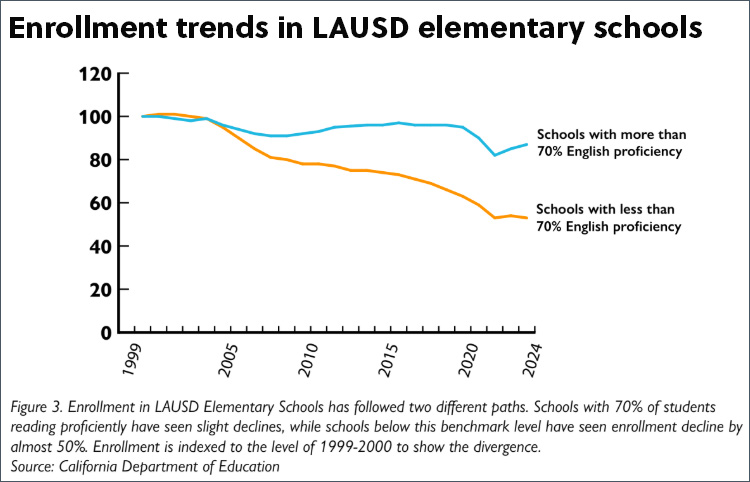
Among the 456 LAUSD elementary schools examined in the report, enrollment is down 46% from their peak over the last two decades, while over half of these schools have seen enrollment decline by over 50%.
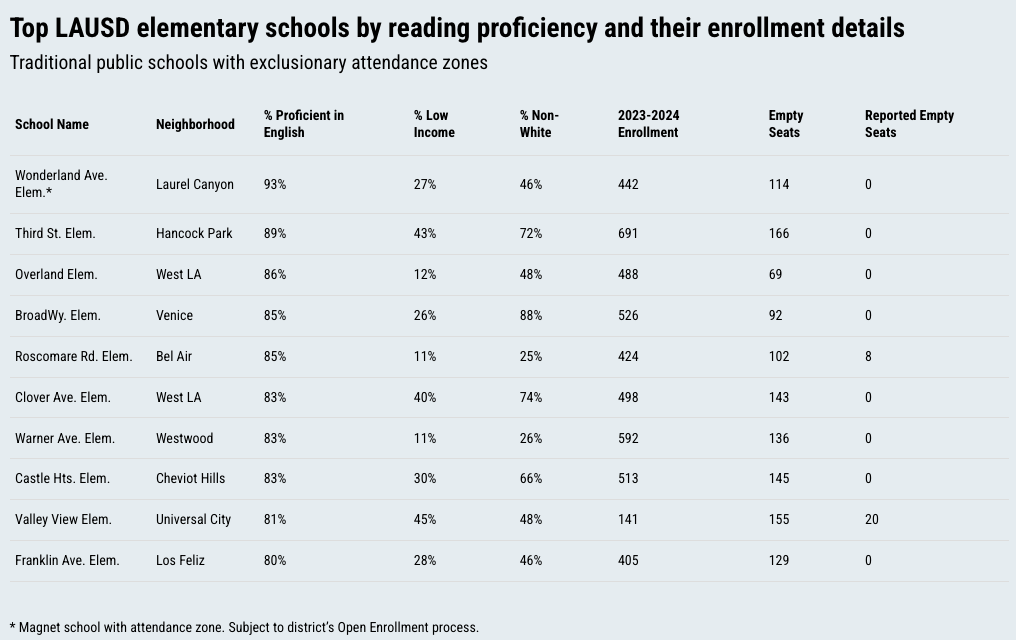
The decline has left a lot of open space in 39 high-performing schools, but that doesn’t mean LA students are filling them, according to DeRoche’s analysis. In fact, he and his team found nearly 7,000 empty seats in the sought-after schools.
DeRoche said that leaves a lot of empty seats at those schools and others like them.
For example, high-scoring Ivanhoe Elementary in Silverlake enrolled 432 students in 2024, down from its peak of 467 students, leaving 35 empty seats, according to DeRoche’s analysis. Overland Elementary in West L.A. enrolled just 488 students, down from its peak of 557. Lanai Road Elementary in Encino had ten empty seats, according to the report.
Under state law, traditional district schools are required to offer available seats to any LAUSD student who lives outside of the school’s attendance zone.
LAUSD officials disputed the findings and methodology of “Crisis in the School House,” saying its use of peak enrollment to measure school capacity is inaccurate, because those schools were overcrowded then.
DeRoche admitted his measurements were imperfect but said the gist of his analysis stuck.
Given the fact that most kids in L.A. attend lower-performing schools, and that the district is with no end in sight, DeRoche to open those high-performing schools up by reassessing enrollment zones.
“We’re trying to work for a system in which there’s more equitable access to these really coveted public schools, and it’s not based on your wealth,” said DeRoche, who on U.S. attendance zones.
DeRoche’s critique of admissions comes as LAUSD is contracting. Since the pandemic, the district has lost more than 70,000 students. Current enrollment sits at 408,083, down from a peak of 746,831 in 2002.
Decades of shrinking classes recently prompted L.A. school board president Scott Schmerelson to say district leadership needs to start talking about closing or combining schools, something that some other big U.S. cities are already doing.
Superintendent Alberto Carvalho has countered with a proposal to close down unused parts of school campuses while keeping schools operational, a tactic LAUSD is already deploying at some campuses.
“Crisis in the School House” focuses in part on a group of L.A.’s two-dozen top-scoring traditional district elementary schools.
The report’s analysis of enrollment data for last year shows those schools had room for at least 4,306 more students. In addition, the report found almost 3,000 additional seats in district-run charter schools. But just four district schools reported only 58 open seats in the district’s Open Enrollment system for incoming students, DeRoche said.
The upshot is that kids, including those most in need, are shut out of good schools, said DeRoche, something he’s seen happen in around the country.
Like those of other districts, Los Angeles schools post uneven scores on state exams, with lower-income, mostly minority schools earning lower marks. This matters, said DeRoche, because it perpetuates cycles of poverty and hands an unfair advantage to the wealthy.
Of the 456 LAUSD neighborhood elementary schools in DeRoche’s study, just 39 managed to get 70% or more of students reading at grade level. In those 39 schools, 45% of the students were white, while the other 417 schools in the study were only 7% white.
In an interview, LAUSD’s senior executive director of strategy and innovation Derrick Chau said DeRoche also failed to account for important programs that are serving district students, such as magnet schools.
“We do have programs that have been and continue to be in high demand,” said Chau. “The reality is, as a system, we are recalibrating across the board on how to deal with changing enrollments.”
Chau said the district is pursuing a number of tactics to boost enrollment in schools and also ensure seats in sought-after schools are distributed in a fair and equitable manner.
“I think we just need to readjust our system to make sure that we look at those programs, replicate them, and bring them to more students,” he said.
Did you use this article in your work?
We’d love to hear how The 74’s reporting is helping educators, researchers, and policymakers.